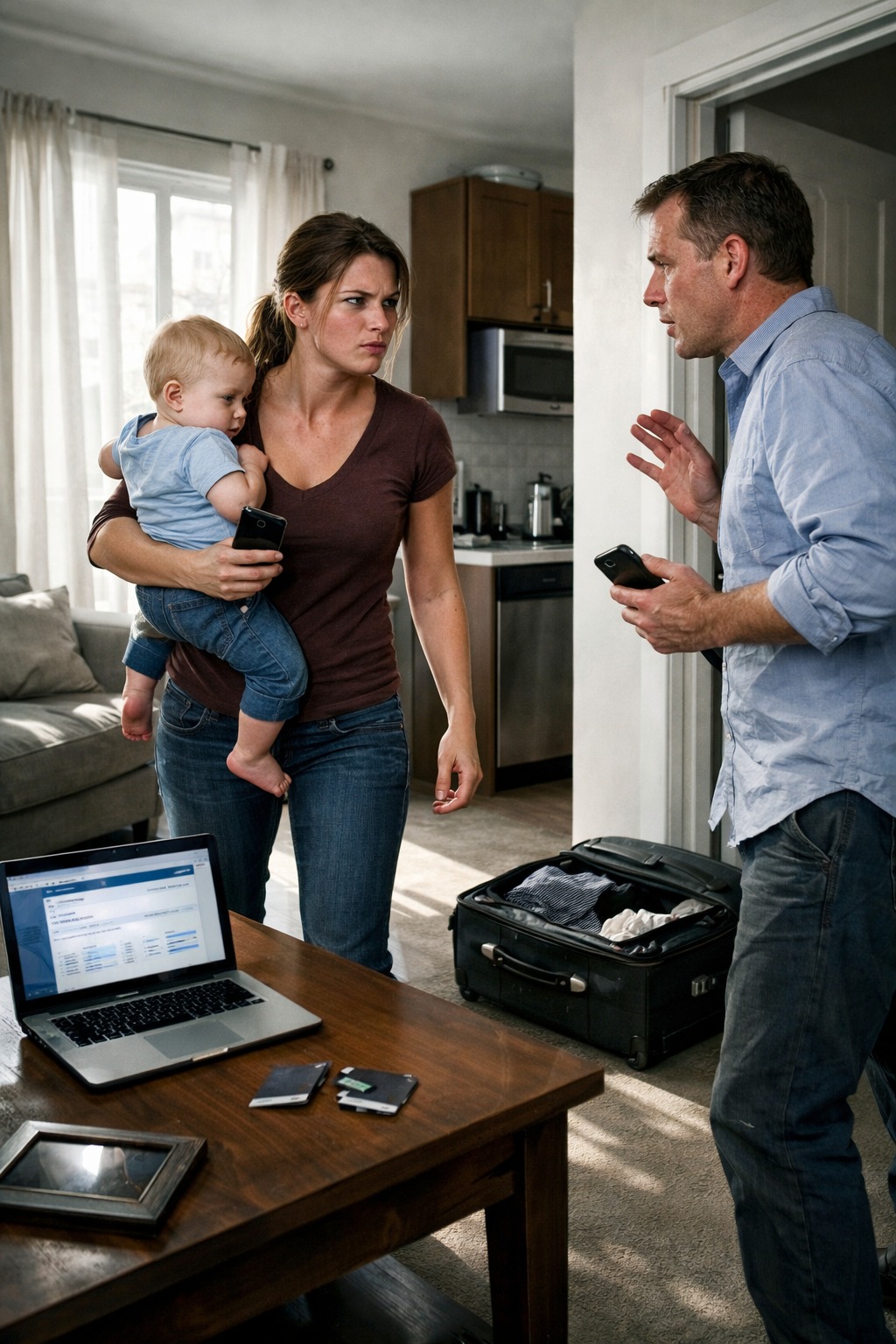
“My husband led a double life for four months.” While I was raising our baby alone, he flew to his mistress and emptied our accounts. Twenty thousand dollars. Gone. And when I found out the truth, it only got worse. Because this wasn’t his first betrayal.
Part 1
At three in the morning, the house sounds different.
In my parents’ place, the old air conditioner clicks on and off like it’s thinking about it. The refrigerator hums a steady note. Somewhere down the hall, the floorboards complain when my dad shifts in his sleep. My son—three months old, warm and heavy against my chest—makes those tiny newborn noises like he’s dreaming of milk.
I’m on the carpet in the spare room, my back against the bed frame, laptop balanced on a pillow because my wrists are too tired to hold anything up anymore. The glow of the screen makes the walls look pale blue. I keep telling myself I should sleep whenever he sleeps. I keep not doing it, because my head feels like a shaken snow globe and if I close my eyes the memories start falling again.
My husband is named Alex.
He’s thirty-one.
Or rather, he was. Not legally. Not on paper. But in every way that mattered—trust, safety, the feeling that someone had your back—he stopped being my husband a while ago. It just took me months to admit it out loud.
I used to think the happiest chapter of my life would start when our son arrived.
I didn’t realize I was already living the opening scene of the worst.
Seven years ago I was twenty, working at Bean and Leaf, a little coffee shop near a glass office building downtown Raleigh. The espresso machine was older than some of the customers and hissed like a dragon whenever I pulled a shot. I wore my hair in a messy bun, smelled like roasted beans and vanilla syrup, and kept a textbook propped open under the register whenever the manager wasn’t looking.
I was in my final year of college, studying to be a teacher. I didn’t want my parents to pay for everything. They offered. They would’ve done it without a second thought. But pride is a stubborn thing, and I wanted to build my own life with my own hands.
Alex walked in at exactly 8:15 a.m. every weekday.
The first morning I noticed him because he didn’t glance at the menu even once. He stepped up, polite but brisk, and ordered a cappuccino without sugar and a croissant with almond butter. Then he moved to the same table by the big picture window, opened his laptop, slid on headphones, and disappeared into whatever world lived behind his serious face.
Business suit. Clean haircut. Watch that probably cost more than my car.
The next day, same time, same order.
The third day, same.
By the fifth day, I had his cappuccino ready before he even reached the counter. When I set it down, he pulled one earbud out and looked up like he was surprised the world still existed.
“Thank you,” he said. And then, like it slipped out before he could stop it, “You make the best cappuccino in town.”
I laughed, heat rushing to my cheeks. “Pretty sure that’s the machine, not me.”
His mouth tilted. “I’ve had the same machine at other places. Not the same cappuccino.”
It was such a small thing, but it landed in me like a coin dropping into a jar. The first of many.
After that, he started talking. Just little things at first. The weather. The line at the DMV. How downtown always smelled like hot pavement in August. Then bigger things: how he’d moved to Raleigh for work, how his schedule was brutal, how he liked coming to Bean and Leaf because it felt like a pause button.
He asked me my name. What I studied. What I wanted to do when I graduated.
“Teach,” I said. “Elementary school. I like the chaos.”
He grinned, the corners of his eyes crinkling in a way that made him look less like a man in a suit and more like someone you’d want at your dinner table.
“You must be patient,” he said.
“Or stubborn,” I told him.
“Same thing,” he said, like it was a compliment.
The first time he asked me out, it was gentle. No pressure. He slid a napkin across the counter with his number written neatly in the corner.
“If you ever want to get coffee somewhere that isn’t your workplace,” he said, “text me.”
I waited three hours before I did, because I didn’t want him to think I’d been staring at the napkin the whole shift.
I had been.

The months after that played out like the kind of love story people put on beach-read book covers. Alex didn’t just ask me out; he courted me. He brought me coffee to my apartment on weekends, the kind I liked—caramel latte, extra foam—like he was keeping notes. He sent long messages at night, not just “goodnight,” but paragraphs: thoughts, dreams, silly observations about strangers on the street.
One evening, after a particularly brutal day where my professor tore apart my lesson plan, I got home and found a grocery bag hanging from my doorknob. Inside: a frozen pizza, a pint of cookie dough ice cream, and a sticky note that said, You can’t change the world on an empty stomach. Call me when you’re ready to laugh again.
I cried, but in a good way.
A year later, I moved into his one-bedroom apartment. It was bigger than mine, in a neighborhood where the trees shaded the sidewalks and there was a park across the street. I remember carrying boxes of books up the stairs, sweating through my shirt, and Alex meeting me at the door like I was something precious he’d been waiting for.
He’d cleared half the closet. Bought shelves for my novels and teaching binders. Put a basket in the bathroom cabinet with a little label that said Mine, because he thought he was funny.
“This is our home now,” he said, wrapping his arms around me from behind while I lined my books up by genre like a nerd. “Everything is ours.”
I believed him because I wanted to. Because he sounded like someone who meant it.
His parents loved me, at least in the way families love someone who makes their son seem happier. His mom, Carol, was the kind of woman who hugged with her whole body, cheeks rosy, laugh loud enough to fill a room. She started calling me “daughter” before Alex and I were even engaged. She taught me how to make her apple pie, passing down family stories along with the recipe.
“I’m so glad Alex has finally settled down,” she told me once, squeezing my hands. “He’s dated a lot, but you’re the first he’s been serious about. You’re special.”
His father, Robert, was different—tall, quiet, the kind of man whose posture made you sit up straighter by accident. He asked questions like an interview: my goals, my plans, how I felt about money. He didn’t smile often. But when he did, it felt earned.
My parents were wary at first.
My mom pulled me aside after Alex came over for dinner the first time. “He’s too perfect,” she whispered in the kitchen while Alex helped my dad carry dishes to the sink. “Nobody’s that perfect.”
“He’s just… good,” I insisted.
My dad didn’t argue with me, but he watched Alex like he was measuring him. Alex passed every test. He fixed a leaky faucet. He helped my dad with the car. He complimented my mom’s garden with enough specifics that she couldn’t call it fake. He knew how to be what people expected.
Back then, I thought it meant he cared.
Now I know it meant he was skilled.
Two years later, on my twenty-third birthday, Alex proposed on the North Carolina coast. He told me it was just a weekend getaway. He booked a little place near the beach, not fancy, but cozy, and we spent the day walking barefoot in the surf, eating shrimp tacos from a food truck, laughing at the way seagulls bullied tourists.
At sunset, we were walking along the sand when he stopped.
He took my hands. His palms were sweating.
“I knew the first morning in that coffee shop,” he said, voice trembling, “that you were the one. You make every day better just by existing.”
Then he dropped to one knee right there in the sand.
“I want to wake up next to you every morning for the rest of my life,” he said. “Will you marry me?”
I cried so hard I could barely nod. He slid a simple silver ring with a small diamond onto my finger, like a promise you could hold.
He later confessed he’d saved for six months, skipping lunches, saying no to trips with friends, all so he could afford it.
I believed that was love.
Our wedding was small. Fifty people. Family, close friends, a backyard reception with twinkle lights and barbecue and Carol crying into a napkin every time she looked at us. Alex and I said vows that sounded sacred because we meant them.
For better or worse.
For richer or poorer.
In sickness and in health.
I remember looking at him and feeling sure. Like I’d made the safest decision of my life.
If you’d told me then that within a few years I’d be sitting on my parents’ floor at three in the morning with a baby in my arms, trying to figure out how someone can smile at you all day and betray you all night, I would’ve laughed in your face.
I would’ve said, Not Alex.
Not my husband.
But love has blind spots. And Alex—God, Alex knew exactly where mine were.