My brother PUNCHED my 8-year old daughter’s FACE for a chocolate. Parents said: “POOR PEOPLE DON’T EAT THOSE.” They laughed at her tears. So I made ONE CALL to the Cops The $5,000 FINE destroyed them!
Part 1
The night my brother punched my eight-year-old daughter over a chocolate bar was the night I stopped being his sister.
Not when he called me the poor one at Thanksgiving, loud enough for our cousins to hear. Not when he “forgot” to invite me to his new housewarming party, then posted the whole thing online with a caption about family being everything. Not even when my parents, for the hundredth time, made excuses for him that sounded like they were reading from a script they’d memorized years ago.
It was when my little girl looked up at me, one hand pressed to her cheek, confusion swimming in her eyes, and whispered, “Mommy, what did I do wrong?”
Something inside me went cold.
My brother, Dylan, has always been the kind of man who makes people straighten their posture when he enters a room. He’s tall, broad-shouldered, with the easy confidence of someone who has never been told no and believed it. He wears expensive cologne and a smile that looks warm until you study it too long. Then it becomes obvious: it’s not warmth. It’s performance.
To the outside world, Dylan is success with a perfect haircut. Self-made businessman. Luxury cars. Big house in the suburbs where the lawns look like they were trimmed with a ruler. The kind of guy who posts motivational quotes about grit and hustle while sipping whiskey that costs more than my weekly grocery budget. He’s the golden child, the hometown story everyone loves because it lets them believe the world is fair.
To my parents, he’s proof they did something right. They hold him up like a trophy.
And me?
I’m the single mom who never quite got it together. That’s the family label, like it’s printed on my forehead.
I rent a small apartment above a nail salon. I work two jobs, one at a medical billing office and the other waiting tables on weekends. I buy groceries with coupons and plan my meals like a military operation. I don’t post pictures of designer watches. I post pictures of my daughter’s lopsided clay animals from art class because she insists they have feelings.
My daughter, Emma, is my whole heart walking around outside my body.
She has my eyes and my patience, which makes me laugh because I don’t know where she found the patience. She’s quiet around strangers but hilarious when she feels safe. She’ll talk to a ladybug like it’s a neighbor and apologize to the microwave when it beeps too loudly. She is the kind of kid who makes you remember the world is still worth fighting for.
Dylan doesn’t see any of that.
When he looks at Emma, he sees an extension of me. And when he looks at me, he sees the life he’s grateful he didn’t end up with.
Here’s what most people don’t know: when Dylan was starting out, when he was still working out of a cramped rented office with a folding table and a printer that jammed every ten pages, I was there.
I didn’t have money to invest, but I had time at night after I’d put baby Emma to bed. I’d bring my laptop over and help him make sense of paperwork. I formatted proposals. I tracked invoices. I answered early client emails because Dylan didn’t know how to sound professional without sounding like a robot. I did it because I thought that’s what sisters do. I did it because I wanted to believe, even then, that our family could be something other than a hierarchy where Dylan sat at the top.
He calls himself self-made.
I call him selectively grateful.
Still, I didn’t ask for credit. I didn’t want his spotlight. I wanted peace, the kind of peace that comes from not being a problem in your parents’ eyes. The kind of peace that comes from keeping your head down and choosing your battles.
That’s why, when my dad called and invited us to his sixty-fifth birthday party at Dylan’s house, my first instinct was to say no.
Dad’s voice had that soft hopefulness that always gets me. “It would mean a lot if you came,” he said. “Your mom’s been… she’s been talking about having the family together.”
I glanced at Emma at the kitchen table, tongue sticking out as she concentrated on drawing a card for Grandpa. She had written HAPPY BIRTHDAY in purple marker and added a crooked cake with too many candles. Underneath, she’d drawn a stick figure version of my dad with a big smile and a balloon that said GRANDPA.
Emma looked up at me. “Can we go, Mom? Please? I want to give him this.”
She was excited. She’d already picked out her favorite blue dress, the one with tiny embroidered flowers and a skirt that twirled just right. She’d asked if she could wear the sparkly shoes that pinch her toes because, in her mind, grandpa’s birthday was an event worthy of mild suffering.
I told myself it was just one night.
Be civil. Smile. Leave early.
I should have trusted the tight feeling in my chest that whispered, Don’t take her into that house.
But it was my father’s birthday. And I kept thinking, Dylan will behave in front of guests. Dylan knows how to look good. Dylan loves looking good.
So we went.
Dylan’s house looked like it belonged in a magazine that costs twelve dollars at the checkout line. Marble floors. High ceilings. A staircase that curved like a movie set. The air smelled like catered food and expensive candles. People in crisp outfits laughed in groups, holding glasses that clinked softly like they belonged in their hands.
Emma squeezed my fingers as we walked in, her eyes wide. “Wow,” she whispered, like we’d entered a castle.
Dylan swept across the room, hugging my dad loudly, saying things meant to be heard. “Family is everything,” he announced, raising his glass like he was giving a speech. “Nothing matters without family.”
Family.
He said it while barely looking at me.
He did that thing he always does, the half-hug where his arm touches your shoulder but his body stays angled away, like affection is something he can’t fully risk. His eyes flicked to Emma, then away.
My mother appeared beside him, hair perfectly styled, smile stretched. “There you are,” she said, like I was a late delivery.
“Hi, Mom.” I kept my voice steady.
Emma held up the card. “Grandpa, I made you this!”
My dad’s face softened in a way I didn’t see often anymore. He crouched down and took the card like it was made of gold. “This is beautiful, sweetheart,” he said. “Thank you.”
Emma beamed, and for a moment I let myself believe the night might be okay.
For a while, it almost was.
Emma stayed close to me at first. Big crowds make her shy. She hid behind my hip when a woman with bright lipstick leaned down and said, “Aren’t you adorable?”
But then Dylan’s son, Noah, came barreling into the room, nine years old and full of energy, and tugged Emma’s hand. “Come play,” he said, like it was a command kids are allowed to give.
Emma glanced at me for permission.
I nodded. “Stay where I can see you,” I said.
They ran to the living room where gift bags were stacked and a long coffee table was covered in snacks: fancy crackers, little cheese cubes, fruit arranged in shapes that looked like art. And in the center, in a bowl like it deserved its own spotlight, were chocolates wrapped in glossy paper.
I watched Emma laugh as Noah made silly faces, and my shoulders loosened. I turned toward the kitchen to help my aunt with plates, letting myself blend into the background the way I always do in Dylan’s world.
Then I heard it.
A sharp voice. Not a child’s voice.
Dylan’s voice.
Then silence.
Not kid silence. Adult silence. The kind that spreads across a room when something has gone very, very wrong.
I turned so fast my stomach lurched. I pushed through the doorway into the living room.
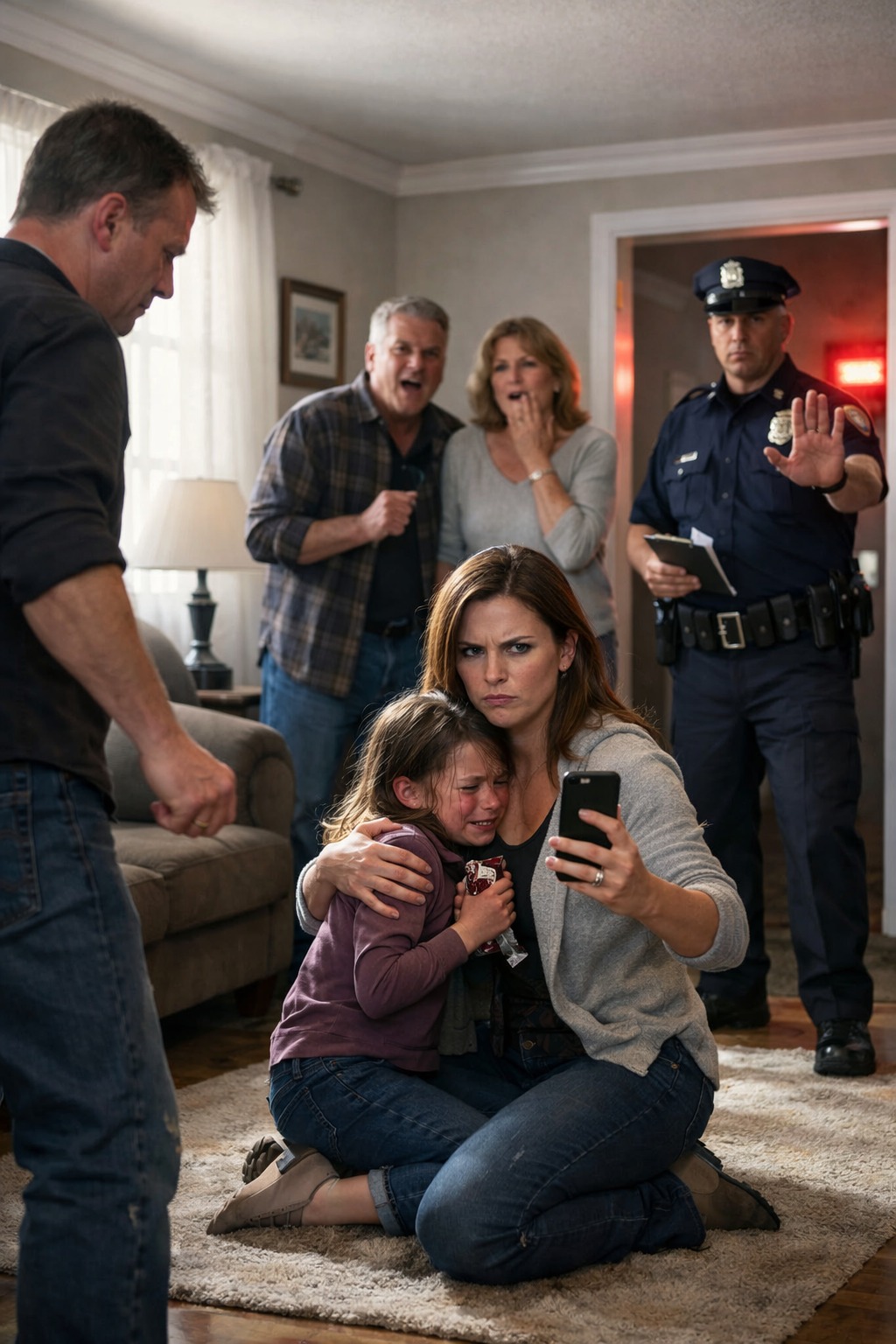
Emma was on the floor.
One small hand pressed to her cheek.
Her eyes wide, stunned.
Noah stood by the couch crying, his shoulders shaking.
And Dylan was standing over my daughter, his jaw tight, his fists still slightly clenched like his body hadn’t caught up to what he’d just done.
“What happened?” I heard myself say, but my voice sounded far away, like it belonged to someone else.
Dylan didn’t look embarrassed.
He looked annoyed.
“She needs to learn boundaries,” he said calmly.
I dropped to my knees beside Emma. Her cheek was already turning red, swelling under my fingers when I touched it gently. She flinched, not from pain alone but from fear.
“She just ate a chocolate,” Noah sobbed. “I told her she could have one—”
“A chocolate?” I repeated, my brain refusing to accept the words.
Dylan’s eyes flicked to the bowl on the table. “Those were imported,” he said, like he was talking about stolen diamonds. “They’re not for just anyone.”
I stared at him. “You hit my child.”
“She provoked it,” he said, too quick, too practiced.
Emma’s lip trembled. She looked up at me, confused, trusting. “Mommy,” she whispered, “what did I do wrong?”
That was the moment something inside me went cold.
I stood up, slowly, keeping Emma close. The room felt like it tilted. Guests hovered, watching, but no one moved. My mother’s hand fluttered to her chest. “Maybe she should have asked first,” she murmured.
My dad didn’t speak. His face was pale, eyes darting like he was trapped between what he saw and what he wanted to believe.
And Dylan just stood there, breathing through his nose, waiting for the room to agree with him.
That’s when I understood.
This wasn’t about chocolate.
This was about status.
And my daughter had just paid the price for it.
I didn’t scream. I didn’t cry. Not in front of him. Not in front of them.
I lifted Emma into my arms. She clung to me like I was a life raft.
“It’s okay, baby,” I whispered into her hair. “Mommy’s got you.”
Then I walked into the hallway, pulled my phone out, and dialed 911.
The call was short.
Facts. Clear. Unemotional.
My voice didn’t waver, even though my hands shook so hard I had to brace the phone against my cheek.
When I hung up, a strange calm settled over me, heavy and steady.
For once, I wasn’t powerless.
And Dylan, with all his money and polish and perfect-image speeches, had just made the biggest mistake of his life.