Part 2
The dispatcher kept her voice calm, like she was talking me through a flat tire instead of the moment my family cracked in half.
“Are you in a safe location?” she asked.
“I’m in the hallway of the house,” I said, staring at the framed family photos on the wall. Dylan’s wedding portrait. Dylan shaking hands with a local politician. Dylan and my parents smiling on a beach, all white teeth and matching outfits.
“Yes,” I added, because the question didn’t mean what it should have meant. “I’m safe. My daughter isn’t hurt anywhere else, just her face. It’s swelling.”
“Is the person who hit her still there?”
“Yes.”
“Is he armed?”
“No.”
“Officers are on the way.”
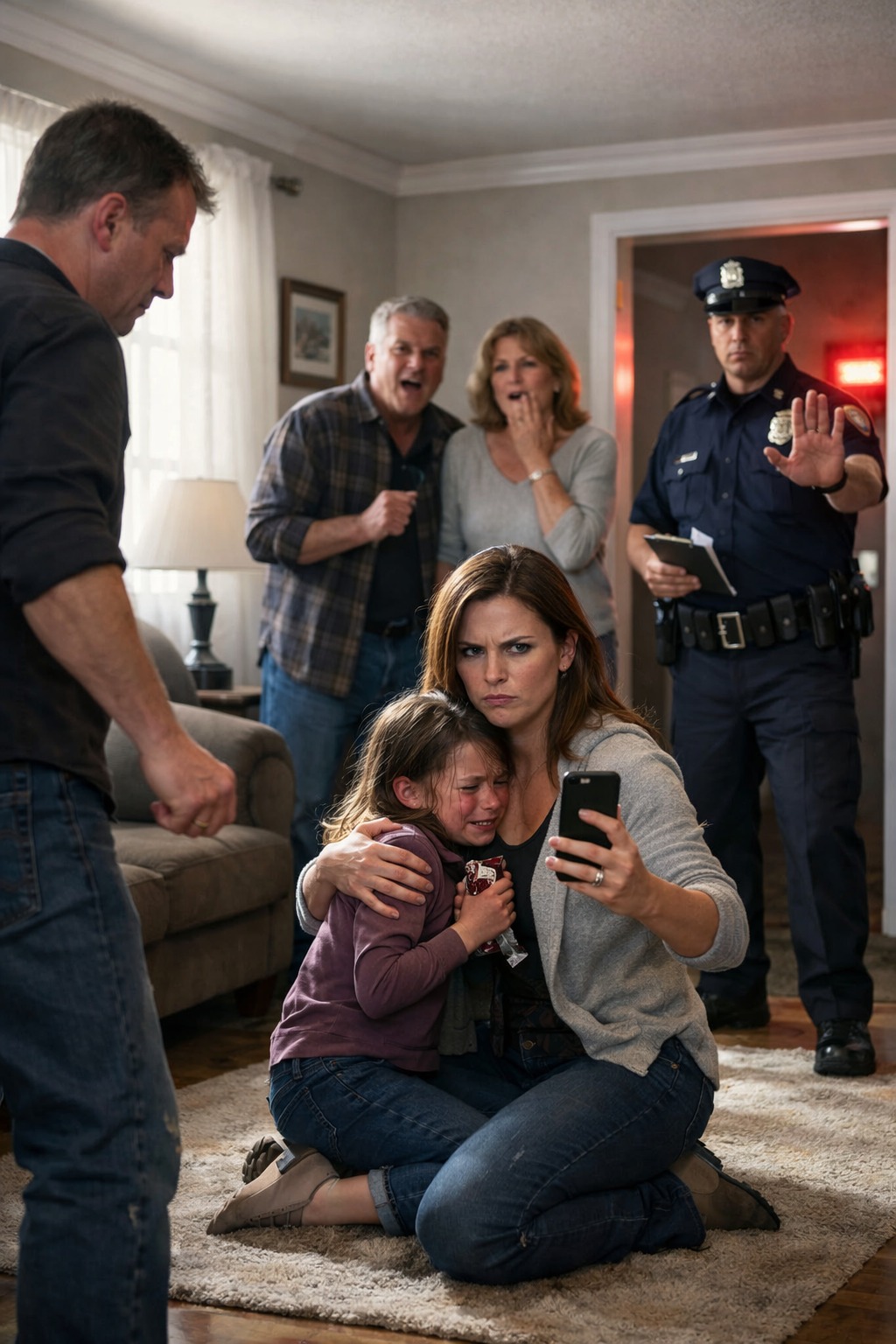
I ended the call and looked down at Emma. She was trembling, her small fingers curled into my shirt like she was trying to crawl back inside me.
“Am I in trouble?” she asked. The words were muffled against my collarbone.
My throat tightened so hard it hurt. “No,” I said firmly. “You didn’t do anything wrong.”
She blinked up at me, tears stuck in her lashes. “Uncle Dylan looked mad.”
“He was wrong,” I said. I wanted to say more. I wanted to explain the whole ugly world to her in one sentence and then burn it down so she’d never have to see it again. But she was eight. She still believed adults were supposed to be safe.
I held her and breathed until my heartbeat slowed enough to think.
The living room behind us buzzed with low voices. People had started moving again, like the scene was shifting back into the party it was supposed to be. I could hear someone say, “Maybe we should give them space,” and someone else reply, “Dylan’s under a lot of pressure.”
Pressure. Like that was a reason.
My mother stepped into the hallway, smoothing her blouse like she was preparing for a photo. “Honey,” she said carefully, like she was approaching a skittish animal. “Let’s not make this bigger than it needs to be.”
I stared at her. “He punched her.”
Her eyes flicked to Emma’s swelling cheek, then away. “He didn’t mean it like that,” she said. “It was… a reaction.”
“A reaction,” I repeated, my voice flat.
“She took something without asking,” my mother insisted, as if that were the crime of the century. “You know Dylan. He’s particular. Those chocolates were expensive.”
I felt my mouth curve into something that wasn’t a smile. “Are you hearing yourself?”
My mother’s face tightened. “You’re always so dramatic.”
That word landed like a slap. Dramatic. Like I was the problem for naming what happened.
My dad appeared behind her, shoulders slumped. He looked older than he had an hour ago. “Rachel,” he said softly, his voice full of pleading, “let’s just talk about it. Dylan will apologize. We’ll handle this as a family.”
“As a family,” I echoed. I looked past him, down the hallway, and saw Dylan standing in the doorway of the living room. He wasn’t coming toward us. He wasn’t checking on Emma. He was watching like he was waiting for me to back down.
He lifted his chin slightly, that familiar challenge. The look that said, You won’t do it. You won’t embarrass me.
I adjusted Emma higher in my arms and met his eyes. “No,” I said to my father. “We won’t.”
My dad’s brows knit. “What do you mean?”
“I mean I called the police.”
The hallway went silent, like someone had turned the volume knob to zero.
My mother’s mouth opened. “You did what?”
Dylan stepped forward, his face shifting from annoyance to something sharper. “Are you kidding me?” he snapped. “This is ridiculous.”
I didn’t answer. If I spoke, the calm might break and something ugly might come out. I focused on Emma’s breathing instead, slow and shaky.
My mother grabbed my arm. Her nails dug into my skin. “You can’t do this,” she hissed. “Do you understand what you’re doing? Do you know how this will look?”
I looked down at her hand on my arm, then back at her face. “You’re worried about how it will look,” I said quietly. “Not about what it is.”
Her grip loosened as if my words burned.
Dylan scoffed. “She’s fine,” he said. “It barely touched her.”
Emma flinched at his voice, burying her face in my shoulder.
Something in me hardened further. I turned my body slightly so Emma couldn’t see him.
“It didn’t barely touch her,” I said. “It hit her. You hit her.”
Dylan threw his hands up. “She provoked me,” he insisted. “She walked in and just grabbed one like she owned the place. She needs to learn boundaries.”
“She’s eight,” I said, and my voice finally shook with something darker than fear. “She’s a child.”
My dad looked like he might be sick. “Dylan,” he whispered.
Dylan’s jaw twitched. For a second, I saw something flicker in his eyes, a tiny crack where shame might have lived if he’d ever let it. Then it was gone.
“I’m not going to have some kid disrespecting me in my own home,” he said. “Especially not when her mother can’t even be bothered to show up with a gift.”
There it was. The real point, delivered like a knife.
I felt Emma’s body stiffen. She heard the tone even if she didn’t understand the words.
I leaned down and kissed the top of her head. “You did bring a gift,” I whispered to her. “You made Grandpa a card. That matters.”
Then I looked back at Dylan. “We’re leaving.”
Dylan laughed, short and sharp. “Good. Go.”
I started walking down the hallway toward the front door. My mother followed, voice rising. “Rachel, stop! Don’t do this! Think about your father!”
My father trailed behind her, silent, torn.
At the entryway, I slipped Emma’s coat on with shaking hands. She winced when the collar brushed her cheek.
“I’m sorry,” I murmured, more to myself than to her.
“Mom,” Emma whispered, eyes big, “are the police going to take Uncle Dylan away?”
I swallowed. “They’re going to make sure you’re safe,” I said. “That’s their job.”
The doorbell rang before I could say more.
My mother froze. My father’s shoulders sank. Dylan, behind us, muttered something under his breath that sounded like a curse.
I opened the front door.
Two officers stood on the porch, one older woman with her hair pulled back tight, one younger man with a notepad already in hand. Their faces were neutral, professional, but their eyes immediately went to Emma’s cheek.
“Ma’am,” the woman officer said gently, “you’re the caller?”
“Yes,” I said. “This is my daughter. She was hit.”
“Can we come in?”
I stepped aside. The officers entered, and suddenly Dylan’s house didn’t feel like his anymore. It felt like a place where reality had finally walked through the door.
The younger officer crouched to Emma’s level, keeping his voice soft. “Hey there,” he said. “What’s your name?”
Emma looked at me first. I nodded.
“Emma,” she whispered.
“That’s a pretty name,” the officer said. “Does your cheek hurt?”
Emma nodded, tears spilling. “It was an accident,” my mother blurted out. “It was just—kids playing—”
The older officer held up a hand, cutting her off without raising her voice. “We’ll get everyone’s statement,” she said. Her gaze moved to me. “Ma’am, can you tell me what happened?”
I told her. Simple. Clear. No embellishment.
My brother punched my eight-year-old daughter in the face because she took a chocolate without asking.
The words sounded insane, even to me. Like something that couldn’t exist in real life.
The officer’s eyes narrowed slightly. “Who hit her?”
I looked straight at Dylan. “He did.”
Dylan’s expression turned theatrical. “This is absurd,” he said loudly, like he was speaking to an audience. “It was an accident. She bumped into me. I barely touched her and now she’s making it into a whole thing.”
The younger officer stood and looked at Dylan. “Sir,” he said, voice steady, “we need you to remain calm.”
“I am calm,” Dylan snapped, which was exactly what calm people don’t say.
Guests hovered in the living room doorway, faces tight with discomfort. Some avoided looking at Emma. Some stared at Dylan like they were seeing him for the first time.
The older officer asked if Emma needed medical attention. I said I wanted her checked. She nodded, already making notes.
Then she asked, “Were there witnesses?”
My stomach sank because in my family, witnesses didn’t mean truth. Witnesses meant loyalty.
My mother cleared her throat. “We all saw it,” she said quickly. “But it was… not like she’s saying. Dylan didn’t punch her.”
The words landed like betrayal, even though I should have expected them.
I stared at my mother. “You were right there.”
My dad’s voice came out hoarse. “Rachel…”
I felt a laugh rise in my throat and die there. I looked at my father, at the way he couldn’t meet my eyes. He’d rather keep the peace than tell the truth, even when the truth was written on Emma’s face.
The younger officer asked Noah what he saw. Noah’s cheeks were wet. He looked at his father, then at me, then at Emma.
“Tell them,” I said softly. “Just tell the truth.”
Dylan’s voice cut in. “Noah,” he warned, low and sharp.
Noah flinched. His eyes darted to the floor.
The older officer stepped closer, her tone firm but not harsh. “Son,” she said, “you’re not in trouble. We just need to know what happened.”
Noah’s lip trembled. “Emma took one,” he whispered, voice cracking. “I said she could. Dad got mad. He… he hit her.”
The room inhaled as one.
Dylan’s face flashed red. “You little—”
“Sir,” the younger officer said immediately, stepping between Dylan and Noah. His hand hovered near his belt, not threatening, just ready.
The older officer’s eyes went cold. “That’s enough,” she said.
My mother looked like someone had yanked the floor out from under her.
My dad closed his eyes, pain etched deep.
And Dylan, for the first time that night, looked like he realized this wasn’t something he could talk his way out of.
The officers separated us. They asked questions. They took photos of Emma’s cheek. They wrote down names. They spoke quietly with a couple of guests who admitted, in hesitant voices, that Dylan’s hand had made contact and Emma had fallen.
Dylan kept repeating, “This is ridiculous,” like it was a magic spell.
Then the older officer turned to him and said, “Sir, based on the statement from the child witness and the visible injury, you’re being cited for assault on a minor. You will receive a court date. If you continue to be aggressive, you may be taken into custody tonight.”
Dylan stared at her like he couldn’t understand English.
My mother made a strangled sound. “You can’t,” she whispered. “He’s… he’s—”
“He’s a grown man,” the officer said, not unkindly. “And that’s a child.”
Dylan’s lawyer-brain kicked in. He straightened his shoulders. “I want to speak to my attorney,” he said stiffly.
“You can,” the officer replied. “Later.”
The younger officer handed Dylan paperwork. Dylan’s fingers shook as he took it, though he tried to hide it by tightening his grip.
The amount on the citation made my breath catch: a fine that would hurt most people, but to Dylan was more insult than injury.
Still, it was something.
It was the law stepping into a space my family had kept lawless for years, because rules had never applied to Dylan inside our walls.
The officers turned back to me. “Ma’am,” the older officer said, “do you have somewhere safe to go tonight?”
I looked down at Emma, at the way she clutched my shirt like it was the only stable thing in the world.
“Yes,” I said.
I didn’t look at my parents. I didn’t look at Dylan.
I carried my daughter out the front door, into the cool night air, and for the first time, I didn’t feel like I was running away.
I felt like I was taking her somewhere he could never reach again.