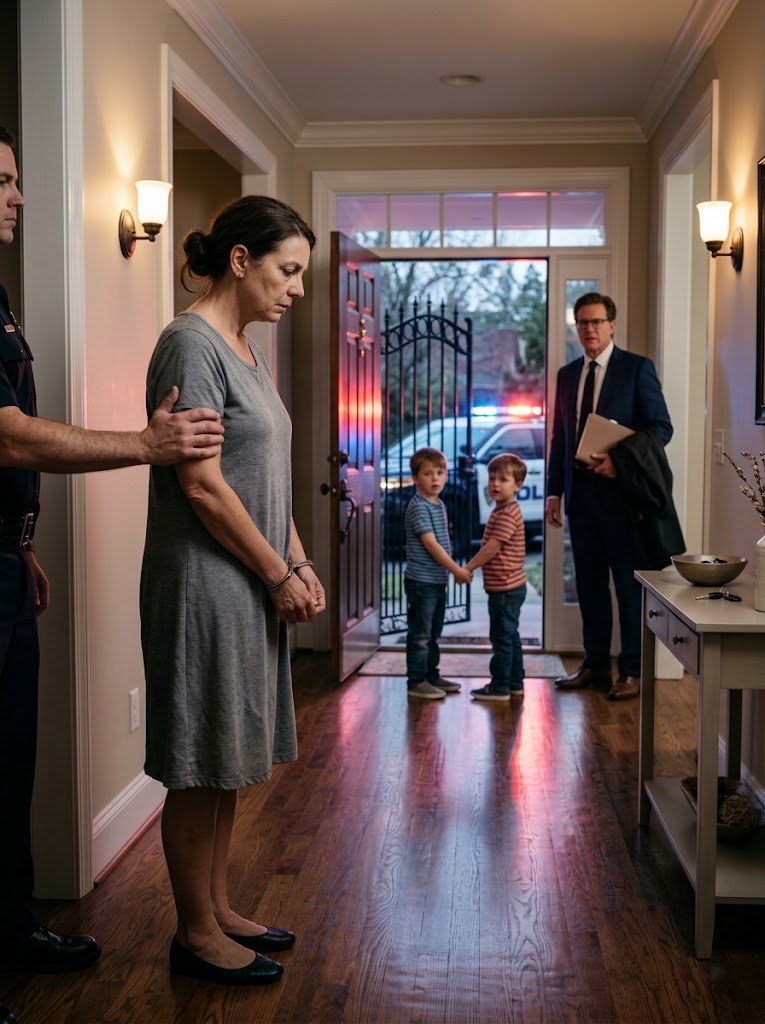
She follows, half crying now, half furious, the sound of someone whose private logic has been dragged into public language and can no longer survive there. She keeps talking as you head down the stairs, words spilling over one another. About emotional boundaries. About unstable staff attachment. About how Carmen acted grateful but was always watching, always learning, always making herself indispensable. It would sound like paranoia if it didn’t sound even more like jealousy.
In the foyer, the twins have escaped Rosa and are standing barefoot at the edge of the hall.
Diego sees the jewelry case first.
“That’s Mommy’s box,” he says.
Valerie freezes.
You kneel in front of your sons. “Boys, I need you to stay with Rosa a little longer.”
Mateo points at the case. “Did Carmelita take it?”
“No,” you say.
The answer lands in the room like a bell.
Valerie makes a soft, strangled sound. Rosa covers her mouth. Diego, who understands more than adults always think children do, looks slowly from the jewelry box to his mother’s face and then back to yours.
“I knew it,” he whispers.
You stand and call the station.
The desk sergeant routes you to the responding officers’ supervisor. Money smooths some roads, but evidence opens gates faster. You do not mention family reputation. You do not ask for discretion. You state the facts. Jewelry reported stolen has been recovered inside the house in a location inconsistent with the original claim. Camera footage shows your wife moving the jewelry prior to the accusation. Charges should be reviewed immediately. You want counsel present for the nanny and a formal correction entered before the woman spends one more unnecessary hour in custody.
The supervisor’s tone sharpens at once.
“Do not disturb the items,” he says. “We’re sending detectives back.”
Valerie collapses into a chair in the foyer like a queen whose throne just remembered gravity. “Alejandro,” she says, voice gone thin, “please. Think about the boys. Think about what scandal will do to them.”
You look at her for a long moment.
Then you answer with the truth she deserves least but has earned most. “You should have done that before the handcuffs.”
The detectives arrive forty minutes later.
Unlike the patrol officers, they do not carry the urgency of street calls. They carry paperwork, skepticism, and the patient appetite of people who know lies tend to molt when left under light. They review the footage. They photograph the jewelry case in your presence. They take Valerie’s statement in the library while one officer remains with you in the foyer. Through the partially closed doors you hear fragments of her voice rising and breaking, hear the thin sophistication peeling away sentence by sentence.
At one point she says, “I was under emotional distress.”
At another, “She manipulated my sons.”
Then finally, in a tone so defensive it might as well be confession, “I never thought they’d actually cuff her in front of the children.”
When the detectives leave the library, their faces have changed.
One of them, a woman named Detective Morales, approaches you. “Mr. Valdes, we are initiating corrective action on the original complaint and reviewing whether false reporting charges are appropriate. More urgently, we’re arranging immediate release for Ms. Carmen Ruiz pending final paperwork. It would help if legal representation met her at the station.”
“Already on the way,” you say.
Morales nods. Then her eyes flick briefly toward the family room, where your sons are visible through the doorway, curled together under a blanket on the sofa. “You might also consider speaking with someone who works with children after acute incidents. What they saw tonight…”
She doesn’t finish. She doesn’t need to.
After the detectives leave, the house enters a new phase of silence.
Not peace. Not yet. This silence has edges. Valerie remains in the library with the door closed. You do not go in. You cannot think of a single useful sentence that does not taste like ash. Instead you sit with the boys until Martin arrives and leaves for the station with one of the firm’s criminal associates. Mateo falls asleep against your side sometime after midnight. Diego refuses sleep, his eyes huge and watchful.
“Is Carmelita coming back?” he asks.
The question cuts deeper than any adult accusation tonight.
“I’m going to do everything I can,” you say.
He studies your face. “Mommy lied.”
“Yes.”
“Why?”
Children ask why as if the world owes them causes that make sense. The older you get, the more you understand how few of them do. Still, he deserves an answer that does not rot his trust before it has a chance to heal.
“Because sometimes grown-ups get scared of the wrong thing,” you say.
He thinks about that.
Then, softly: “Was she scared of Carmelita loving us?”
You close your eyes for one beat.
“No,” you say. “She was scared of you loving Carmelita.”
His little face crumples at that, not because he fully grasps it, but because some instinct in him knows love should never be treated like contraband. He crawls closer and leans against you. In the quiet of the family room, with cartoons flickering unwatched on mute and the city lights far beyond the glass, you feel the architecture of your life changing around you. Not from scandal. From clarity.
At 2:14 a.m., Martin calls.
“Carmen is being released,” he says. “No charges. The station lieutenant is furious. She spent hours in a cell, Alejandro.”
You grip the phone until your knuckles ache. “Where is she now?”
“She was too shaken to say much. I’m having one of our cars bring her to her sister’s apartment in Queens. I can arrange a hotel, security, whatever she needs.”
“Do it,” you say. “All of it.”