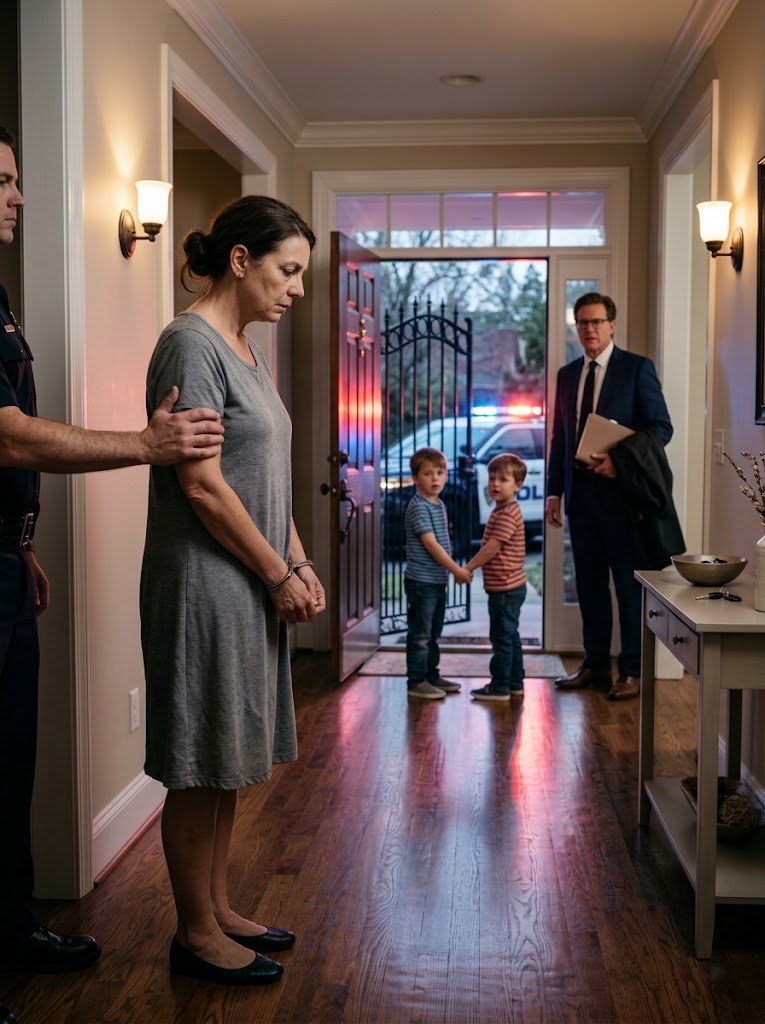
“Calling my attorney. Then I’m calling the station.”
Valerie actually steps toward you. “Alejandro, don’t be ridiculous. This can all be handled tomorrow.”
“No,” you say. “It should have been handled before you had a woman handcuffed in front of my children.”
You make the call.
Your attorney, Martin Hale, answers because he always answers when you ring after 8 p.m. Men like Martin build careers on knowing that wealth breeds emergencies with better upholstery. You explain the situation in clipped sentences. He goes quiet for a moment, then says, “Do not accuse your wife of anything you can’t yet prove. Go to the station. Secure counsel for the nanny if necessary. And Alejandro…”
“Yes?”
“Pull the camera footage now before anyone has time to decide it would be inconvenient.”
You hang up and head for the office.
Valerie follows you halfway down the hall. “You are humiliating me over a servant.”
You stop so suddenly she nearly walks into you.
“No,” you say quietly. “You may have humiliated yourself over one.”
Then you continue downstairs.
The security room is tucked behind the study, disguised by a paneled door because Valerie thought obvious surveillance looked tacky. The irony nearly makes you smile. You enter the code, step into the cool blue glow of monitors, and sit down in front of the control console. Twenty-eight camera feeds map the house and grounds: front gate, foyer, kitchen, upstairs hall, nursery wing, pool terrace, garage, staff entrance, and every major corridor except the bathrooms and dressing room interiors.
Valerie stays in the doorway.
“There are no cameras in the bedroom,” she says tightly.
“Good thing hallways exist.”
You rewind to noon.
Carmen appears on the upstairs hall camera at 12:14 p.m., carrying a vase of fresh white lilies. She enters the primary suite, door half-open, and emerges ninety seconds later with the empty flower bucket and trimming shears. No bulging pockets. No furtive movements. No pause at the closet. She looks exactly like what she is: a woman doing a chore in a rich person’s house.
You keep going.
At 1:03 p.m., Valerie enters the suite alone wearing linen pants and a pale silk blouse. She stays inside for eleven minutes. When she comes out, she is holding her phone and nothing else visible, but she is looking down in the focused way people do when they are staging their own emotional weather. At 1:19 p.m., she calls someone. At 1:31 p.m., she speaks to Rosa in the hall. At 1:46 p.m., she is on the foyer camera with officers at the door.
It is suspicious, but not proof.
Then you go back further.
At 10:08 a.m., before Carmen ever entered the bedroom, Valerie appears on the upstairs hall camera carrying a small cream leather jewelry case. She looks around once, though perhaps you would never have noticed that detail before tonight. Then she walks not toward the primary suite, but toward the south guest room currently used only for seasonal storage.
Your hand stills over the controls.
Why would she take a jewelry case to an empty guest room?
You pull that camera angle.
The south guest room door remains closed for three minutes. When it opens, Valerie emerges without the jewelry case.
You hear your own pulse.
Very slowly, you stand.
Valerie knows it too. You can feel the shift in the air behind you, the exact instant she understands that the camera she forgot may matter more than the ones she remembered. When you turn, she has gone pale.
“What is in the south guest room?” you ask.
She crosses her arms again, but it looks defensive now, not regal. “Probably nothing. I move things all the time.”
You walk past her and up the stairs.
The south guest room sits at the far end of the hall, a room painted a muted blue and decorated by a designer who believed empty spaces should still imply tasteful guests. Valerie reaches the doorway before you and plants herself there.
“This is insane,” she says.
You do not answer. You simply look at her until she moves.
The room appears untouched at first glance. Bed made. Drapes half-drawn. Decorative books arranged on a chair no one has ever actually sat in. But when you cross to the closet and open the top shelf, there it is. The cream leather case, tucked behind an extra stack of monogrammed towels like a secret expecting stupidity to protect it.
You take it down.
Inside are the diamond necklace, the gold bracelet, the emerald earrings, and two other pieces Valerie did not even report missing.
The silence that follows feels almost sacred.
For one second, you do not even feel anger. Just confirmation. That strange, clean horror that comes when your instincts prove themselves in full daylight. When suspicion stops being a feeling and becomes a fact sitting in your hand.
Valerie makes the mistake of speaking first.
“This isn’t what it looks like.”
The sentence is so ancient, so embarrassingly universal, that it almost insults the moment.
You close the case and look at her. “Then please. Be creative.”
Her throat moves. “I put them there because I knew Carmen had been going through my room, and I wanted to see if other things started disappearing.”
You stare.
Then you laugh.
Not loudly. Not kindly. Just once, sharply, because she has chosen an explanation so flimsy it cannot survive basic weather. “You hid your own jewelry in a guest room to test whether a nanny might later become psychic and steal items she didn’t know had moved?”
Valerie’s voice rises. “You always make me sound crazy!”
“No,” you say. “You are doing that yourself.”
She takes a step toward you, eyes bright now with something like desperation. “You don’t understand. She was poisoning them against me. Every time I walked into the nursery they’d run to her first. Every scraped knee, every nightmare, every little question, she answered before I could even open my mouth. They called for her when they woke up. They reached for her in front of guests. Do you know what that feels like? In my own house?”
There it is again.
Not theft. Not betrayal. Rivalry.
You had always known Valerie was not naturally maternal. She liked the image of motherhood better than the labor. She loved curated birthday parties, matching holiday pajamas, Christmas card photographers, and the social theater of preschool admissions. But sick nights bored her. Repetition irritated her. Children’s irrational attachments offended her sense of order because they could not be managed through aesthetics. Carmen, meanwhile, had the kind of quiet competence toddlers treat like oxygen. She fed, soothed, remembered, anticipated, caught the emotional debris before it hit the floor.
And your wife hated her for it.
“You framed her,” you say.
Valerie bursts. “I was going to drop the charges later!”
The words crash into the room.
You do not move.
She hears them too, hears what she has revealed, and claps a hand over her mouth too late. But too late is still enough. In one sentence she has told you everything you needed to know. This was never meant to end in conviction. It was meant to scare. To remove. To teach Carmen the price of becoming too central in a house Valerie considered an extension of herself.
Your voice comes out low and deadly. “You had her handcuffed in front of my children to make a point.”
Tears spring to Valerie’s eyes, but they do not soften her. They arrive like fuel. “I wanted her gone,” she snaps. “Yes. Is that what you want to hear? I wanted her out of this house. Every time those boys looked at her, it was like I was disappearing. I am their mother.”