Part 4
David and Amelia went on their honeymoon, and for a short while, I let myself believe the tension would fade into “wedding exhaustion.”
David posted cheerful photos—beaches, sunsets, matching drinks. He looked happy. Amelia looked like she was performing happiness, but I tried not to read too much into it.
When they returned, David invited us over for lunch at their new place. He sounded excited, the way he always did when he planned to spoil Katie.
We arrived with a bag of toys and a casserole. Katie wheeled into their living room like she owned it, shouting, “Uncle David!”
David appeared instantly, arms wide. “There’s my favorite flower girl,” he said, lifting her into a hug that made her squeal.
He pulled out souvenirs from their trip: a tiny seashell necklace, a plush dolphin, a little photo frame shaped like a starfish.
Katie’s face lit up. “These are for me?” she asked, eyes huge.
“All for you,” David said. “Because you were the best part of my wedding.”
Katie beamed so hard I thought her cheeks might hurt.
I glanced at Amelia.
She stood near the kitchen doorway, holding a dish towel like it was a shield. Her expression was neutral, but there was something underneath it—annoyance, impatience, a silent “how long is this going to take?”
Roger noticed too. I saw his hand tighten around his glass.
Lunch itself was polite. Diane and my dad chatted. David kept checking on Katie, making sure she had snacks and a comfortable spot near him.
Amelia barely acknowledged Katie at all. If Katie spoke to her, Amelia responded with a thin smile and a quick “mm-hmm,” like she was talking to a cashier.
After lunch, while everyone settled into the living room to talk, Amelia approached me quietly.
“Lauren,” she said, soft and controlled. “Can we talk privately?”
My stomach dropped. I already knew.
“Sure,” I said, though my throat tightened.
Amelia led me down the hallway into a spare bedroom. She closed the door halfway, not fully, but enough to make the conversation feel like a trap.
She started with a compliment, like she was reading a script.
“I just wanted to say,” she began, “you did a wonderful job with Katie at the wedding. You followed the dress guidelines. Her hair looked… neat.”
My hands curled into fists at my sides. “Thank you,” I said, because I was still trying to keep peace for David’s sake.
Amelia pulled out her phone. “There’s something that’s been bothering me since the wedding,” she said.
She opened the wedding gallery and started scrolling.
Photos flashed by: David smiling, Amelia glowing, family hugging, Katie in her beige dress, petals on the aisle.
Amelia stopped on a family photo. David stood beside Katie’s wheelchair, one hand resting gently on the handle, his smile wide. Our family gathered around, all of us smiling.
Amelia zoomed in.
Her finger hovered over Katie.
Then she looked at me and said, “Do you see how your stupid kid in a wheelchair ruins the vibe of this entire picture?”
For a second, I didn’t understand the words. My brain refused them, like it was glitching.
Then the meaning hit, and it felt like ice water poured down my spine.
“Excuse me?” I whispered.
Amelia didn’t flinch. “I’m saying,” she continued, voice flat, “that the wheelchair draws attention. People can’t look at anything else. It’s not what I wanted for my wedding photos.”
My hands started shaking, and I hated that she could see it.
“Katie is my daughter,” I said, voice tight. “And she was invited.”
Amelia scoffed. “That’s not my problem. I tried to talk David out of it. But he’s blind about her. If I’d insisted, he would’ve called off the wedding.”
I stared at her, disgust rising like nausea. “So you pretended,” I said. “You pretended you were okay with my child.”
Amelia lifted her shoulders. “It’s not that deep. It’s just… optics.”
Optics.
As if my child was a stain on a dress.
Then Amelia said the part that made my vision go hot.
“I think it’s fair you compensate me,” she said.
“Compensate you,” I repeated, like I was testing the word.
“For the editing,” Amelia said. “A photo editor can remove Katie. Or at least remove the wheelchair. Make it look like she’s… normal. You know. So the photos aren’t ruined.”
The room tilted.
I heard my own heartbeat, loud and furious.
“You want me to pay someone to erase my daughter,” I said slowly, “or erase her wheelchair like it’s shameful.”
Amelia’s eyes narrowed. “You’re being dramatic.”
Something in me snapped. Not in a loud, theatrical way. In a clean break.
I stepped closer. “You are an ableist,” I said, voice shaking with rage. “Katie is not an accessory. She is not a mistake in your aesthetic. She is a child. And she is family.”
Amelia rolled her eyes, the same eye roll from the aisle. “Please. Don’t act like you’re not enjoying the attention. You and Katie both love it.”
My breath caught. “Katie loved being included,” I said. “Because she loves her uncle. Not because she’s trying to steal your spotlight.”
Amelia leaned forward, her voice turning sharp. “If she wasn’t disabled, nobody would’ve cared. People were staring because of the wheelchair. It was embarrassing.”
That word did it.
Embarrassing.
My daughter.
My sweet kid who clapped at cartoons and squealed over seashell necklaces.
Embarrassing.
I felt my hand move before my brain approved it.
The slap wasn’t planned. It wasn’t satisfying. It was a reflex born from years of swallowing rage on behalf of my child.
My palm connected with Amelia’s cheek, and the sound echoed in the small room like a gunshot.
Amelia’s eyes went wide, shock flooding her face. Her cheek flushed red instantly.
My stomach dropped with immediate regret—not for defending Katie, but for giving Amelia a weapon. Now she could point to me and claim I was violent.
I opened my mouth to speak, to apologize for the slap but not for my words, to regain control—
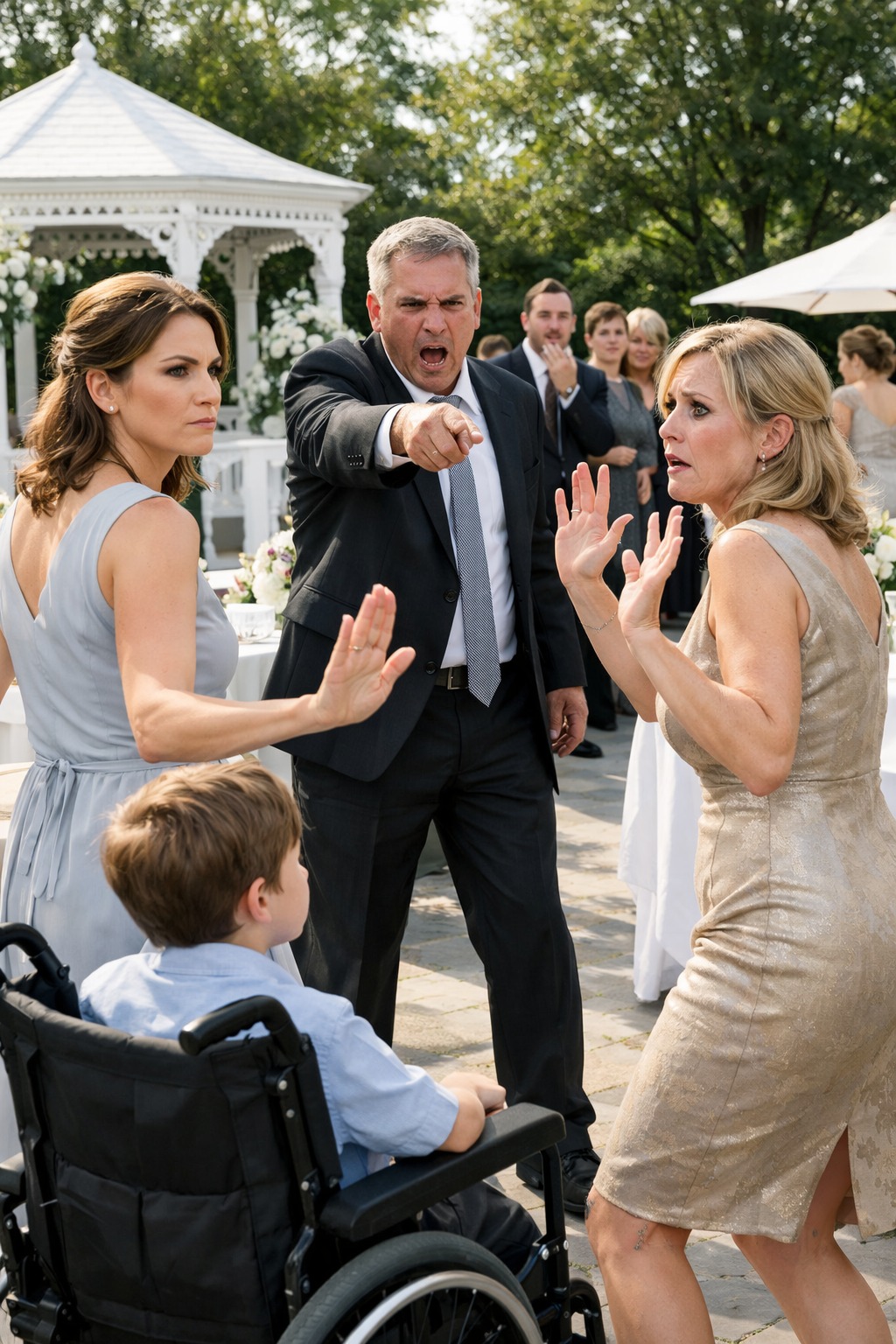
And then the bedroom door swung fully open.
David stood there.
His face was white. His eyes were blazing. Behind him, Roger and my parents crowded the hallway, drawn by the raised voices.
David’s gaze locked on Amelia. His voice came out low and deadly calm.
“Did you really say that about Katie?”
Amelia’s mouth opened and closed like a fish.
Because she hadn’t realized the door hadn’t been fully shut.
She hadn’t realized David had been in the hallway.
She hadn’t realized karma was standing right outside, listening.