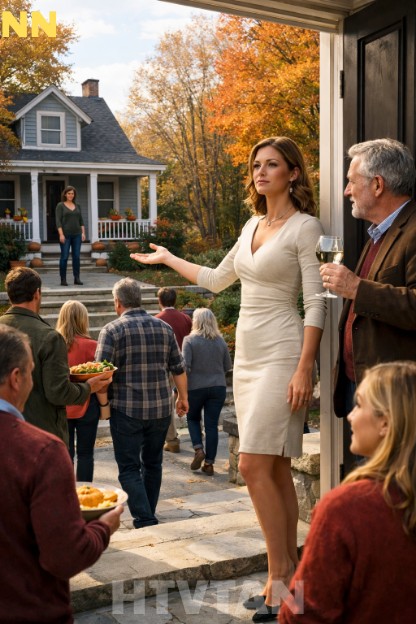
My Sister Erased Me From Thanksgiving Like I Didn’t Exist. Instead Of Begging For Scraps At Her Perfect Table, I Opened The Doors Of My $2M Vermont Estate And Invited Everyone Else. But The One Voice That… Paypack 15 Personal Revenge Seras Silenced Her Wasn’t Mine…
Part 1
The group text lands while I’m pouring coffee.
Steam rises in a thin ribbon, fogging the kitchen window where Vermont’s first real cold snap has turned the world into a watercolor of gray sky and bare branches. The radiator ticks like it’s keeping time. Outside, the lake sits flat and metallic, the kind of stillness that makes you whisper without meaning to.
My phone buzzes once, then again, the way it always does when my family is about to remind me where I rank.
Just Miranda’s family.
That’s all my mother wrote. No hello. No explanation. No “we’re keeping it small this year.” Four words, delivered like a stamp on a file folder: removed.
I stare long enough for the coffee to go bitter.
I’m Magnolia Pierce. U.S. Army Captain. I’ve spent years reading bad intel and keeping my voice steady while people around me panic, because panic spreads faster than shrapnel. Still, four words can punch harder than recoil when they’re aimed at the part of you that’s always been hungry.
The urge to reply flickers. Something polite. Something clever that makes it look like I’m fine. Something that lets me pretend it doesn’t hurt to be erased on purpose.
Training wins.
I set the phone face down on the table and listen to the quiet: the faint creak of old boards, the wind worrying the clapboards, the deep hush that shows up when you realize you’ve been excluded like it’s a family tradition.
Across the kitchen, my grandfather’s old field jacket hangs on a peg by the mudroom door. Heavy canvas. Faded patches. It’s been there since the day I carried it back from his house after the funeral, like a promise I didn’t know how to make yet. He used to wear it when he walked the ridge line behind the lodge, hands in his pockets, eyes narrowed against the sun.
“If they won’t give you a seat,” he’d tell me, “build the table.”
I used to think it was just one of his sayings, like “measure twice, cut once” or “don’t trust anyone who won’t look you in the eye.” Now it lives in my chest with the weight of scripture.
Ashwood Lodge—his lodge, now mine—sits on thirty acres above the lake. The realtor who handled the estate called it “a premium property” like he was selling a dream. The insurance paperwork labeled it at two million dollars, which sounds ridiculous until you stand on the back porch at sunrise and watch the fog lift off the water like a curtain.
The lodge never asked me to shrink. It never cared that I wasn’t the favorite. It only cared that I showed up.
I flip the phone over and read the message again as if repetition might reveal a hidden clause, a softer edge. But it’s the same every time: Just Miranda’s family.
Not “we’re worried about your schedule.” Not “we assumed you’d be on duty.” Not even “it’s complicated.”
It’s comfort. Miranda’s comfort.
In our family, Miranda’s comfort has always outweighed my existence.
For a second, I picture myself driving down to my parents’ house anyway—showing up in my coat, boots clean, hair pinned back the way I keep it for formal events. I picture walking into their spotless dining room, setting a pie on the counter, daring anyone to tell me I don’t belong.
The idea thrills me for half a heartbeat.
Then the aftertaste hits: humiliation disguised as belonging. Scraps passed off as kindness. Smiling through it so nobody calls you dramatic. I’ve lived too long on scraps.
I push back from the table. My boots hit the floor hard enough to echo down the wide hall. The lodge is quiet, but it’s not the empty quiet of being alone. It’s the kind of quiet that waits for your decision.

The drawer in the study sticks before it opens, swollen from the weather. Inside is my grandfather’s stationary: thick cream paper with a faint maple leaf embossed in the corner. The kind of paper people use when they mean what they write.
I carry it to the oak table that dominates the dining room and lay my palm flat on the wood until my pulse slows. The table is scarred with decades of use—knife marks, tiny burns from candles, a faint ring where my grandfather used to set his mug. It’s survived more than any family argument.
I uncap a pen, feel its weight settle into my palm, and form the first line in my head like a mission brief.
Thanksgiving at Ashwood Lodge.
One table. No head of the table.
Bring your whole self.
If they erased me there, I’ll make room here.
I start writing, and with every stroke, the ache in my chest rearranges itself into something clean and purposeful. I’m not staging revenge. I’m building what I’ve been denied.
I can’t remember the first time I realized Miranda was the favorite. Maybe it was the science fair when I stood by my project—planets strung together with fishing line—while Dad rushed out early for Miranda’s piano recital. Or maybe it was when Mom forgot me at basketball practice because Miranda’s ballet bun came loose and that was apparently an emergency.
I was fourteen, teeth chattering on a dark curb. When Mom finally pulled up, she sighed like I was the inconvenience.
That night, I learned my place in the family came after hers. Always.
The pattern stitched itself into me year by year until it felt normal. By eighteen, I enlisted partly because I wanted out and partly because I believed that if I wore a uniform, maybe they’d finally see me.
They didn’t. They saw a phase. A choice they didn’t understand. Miranda rolled her eyes and called me intense, like duty was a personality flaw.
But my grandfather saw me.
He saw the way I swallowed disappointment like it was water. He saw the way I stood straighter around my family, trying to earn basic acknowledgment.
When I deployed the first time, he sent packages—socks, jerky, a note in block letters that said Proud of you. Hold the line. I carried that slip of paper inside my vest through every mission. It mattered more than any parade at home ever could.
Now, years later, the note is folded in my wallet. The jacket is on the peg. The lodge is mine.
And my mother’s text is still glowing on my screen like a final stamp.
I write the last line of the invitation and set the pen down.
Operation Ashwood Thanksgiving begins today.
Not because I’m bitter.
Because I’m done auditioning for a chair.