Part 2
I drove through the night because staying still felt like suffocating.
The city’s skyline shrank behind me, glass teeth against the dark. Evan called twice; I let it go to voicemail the first time, then answered the second because I could hear the worry vibrating through the ringtone.
“Where are you?” he asked softly.
“On my way to Wisconsin,” I said, gripping the steering wheel hard enough to make my knuckles ache. “I… I need to go to Dad’s shop.”
A pause. Then: “Okay. Do you want me to meet you there?”
Not what are you doing, not are you sure, not the subtle judgment my family used like perfume. Just okay.
“I think so,” I whispered.
“I’ll leave at dawn,” he said. “And Amanda?”
“Yeah?”
“Eat something. I’m not kidding.”
I tried to smile, but it came out crooked. “Yes, sir.”
When I was a kid, Dad used to let me sit on a stool beside his workbench, my legs swinging, while he fixed old mantel clocks. Their faces would be cracked, their hands bent, their gears clogged with decades of grime. He’d take them apart carefully, piece by piece, laying the components out like a surgeon.
“People think time is the numbers,” he’d tell me, holding up a gear between his fingers. “But time is the movement. Time is what happens when you’re not paying attention. Don’t waste it on people who don’t see you.”
I didn’t understand what he meant until later—until Thanksgiving dinners in Melissa’s mansion, until I was the one refilling her wine glass while Brandon made jokes about my “little computer hobby.”
Melissa had always been the sun of our family system. Everyone orbited her: employees, board members, country club friends, even Grandpa, who’d built the business from a modest logistics company into an empire.
When I was sixteen, I overheard Grandpa tell Dad, “You threw away your chance. Don’t poison Amanda with your bitterness.”
Dad didn’t yell. He never did. He just said, “I’m not bitter, Walter. I’m free.”
Back then, I thought freedom sounded lonely.
Now, I wondered if loneliness was just the price of dignity.
I left for college on a scholarship, determined to build something on my own terms. Computer science came naturally—patterns, logic, the quiet satisfaction of making a system work. Dad had trained my brain with gears and springs; code felt like the same kind of puzzle, just cleaner.
After graduation, I started a small consulting firm. I was proud of it. I had my own clients, my own invoices, my own small victories.
Then Melissa called.
She acted like it was a reconciliation. Like she’d “forgiven” Dad’s rebellion and wanted to bring me back into the fold. She invited me to lunch at a restaurant where the napkins were folded like sculptures.
“You’re talented,” she said, sipping sparkling water. “And I want to make sure your talent benefits the family.”
The hook came wrapped in velvet. She offered me “a position,” but what she really offered was access: to resources, to mentorship, to Grandpa’s approval. And underneath it, unspoken but loud, was the inheritance.
I told myself I could do both—help them and still keep my independence.
So I created a legal structure: my own company owned the software. Melissa’s corporation would be a client. Vendor access keys. Licensing terms. Everything documented, even if we didn’t sign as formally as we should have, because we were “family.”
Family, in my aunt’s vocabulary, meant flexibility when she needed it and obligation when I did.
At first, it was manageable. I built them a new client portal. I modernized their backend systems. I streamlined their data pipelines.
Then the requests started coming at midnight. Then the weekend calls. Then the casual entitlement: “We need you to hop on right now,” like my time belonged to them by default.
Brandon learned quickly that if he slapped his name on a project, Melissa praised him. So he slapped his name on everything. He’d wander into meetings ten minutes late and say, “Yeah, my team and I have been working on that architecture,” while I sat in the corner, laptop open, biting my tongue so hard I tasted blood.
When I pushed back, Melissa would tilt her head and say, “Don’t be emotional, Amanda. This is business.”
Then, when I asked for a raise, she’d smile and say, “Don’t be greedy, Amanda. This is family.”
The rot started showing about two years in.
A system like ours handled huge volumes of transactions, contracts, vendor agreements. Most people thought “logistics empire” meant trucks and warehouses. But it was really data—routes, pricing, inventory, clients, integrations. If the tech failed, the entire thing stuttered.
That’s why Melissa kept me close.
What no one saw was how often the company was one bad day away from disaster. Melissa had a taste for expensive optics—new offices, rebranding campaigns, charity galas where she could be photographed holding giant checks.
Money poured out. Behind the scenes, she patched the leaks with debt.
I saw it in the wires: transfers in and out, late payments to vendors, sudden influxes from loans that didn’t match the reported revenue. I watched her personally guarantee lines of credit. I watched her shuffle liabilities like cards in a rigged game.
I tried to warn her once. Quietly, in her office, away from Brandon.
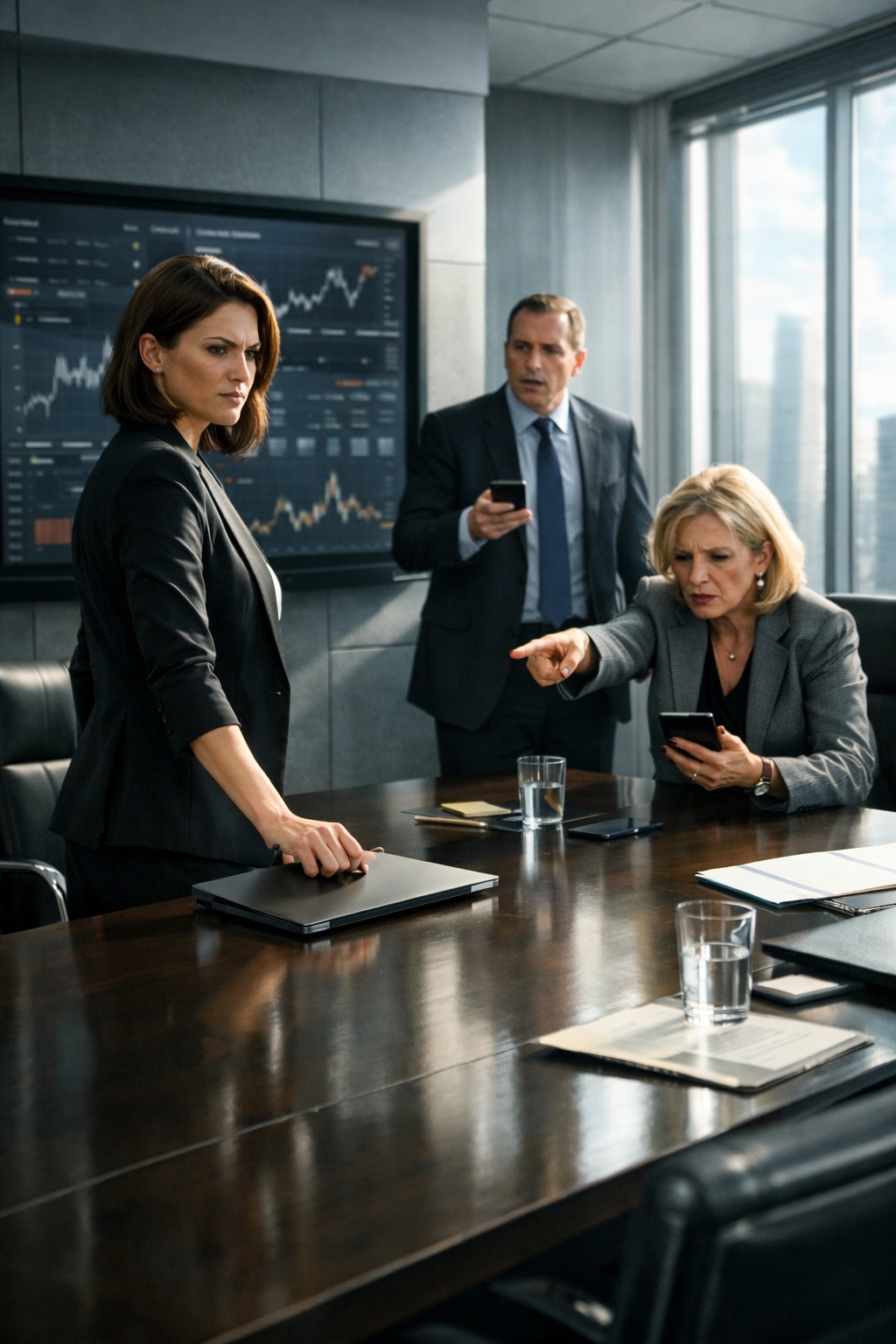
“Melissa, you’re overleveraged,” I said, pointing at a dashboard that showed cash flow trends. “If anything goes wrong—”
She waved me off. “Nothing will go wrong because you won’t let it.”
It was the closest she ever came to admitting the truth: her confidence was borrowed from my competence.
By the time the Apex contract landed—a massive client with strict compliance requirements—I knew it was a test she couldn’t afford to fail. They wanted a full data migration and system upgrade, the kind of project that required planning, staffing, and accountability.
Melissa presented it like a triumph. I saw it as a countdown.
And now my father was dead, and she was telling me I couldn’t take four days to bury him.
When I finally pulled into the small Wisconsin town where Dad lived, the sky was pale, the air so cold it felt sharp in my lungs. Dad’s shop sat on Main Street between a diner and a hardware store, its sign faded but familiar: Ray’s Clock Repair.
I parked and just sat for a moment, watching my breath fog the windshield. The bell above the shop door was still, waiting.
I held Dad’s watch in my hand. Tick. Tick. Tick.
I thought about Melissa’s text. About Brandon’s sneer. About how my life had shrunk into their emergencies.
Then I opened the car door and stepped out into the cold, the sound of gravel crunching under my shoes loud in the quiet morning.
I walked to the shop door, turned the key, and pushed it open.
The brass bell chimed, bright and simple.
And for the first time since the hospital, I felt like I could breathe.